|
Children of Bond - Flight 714
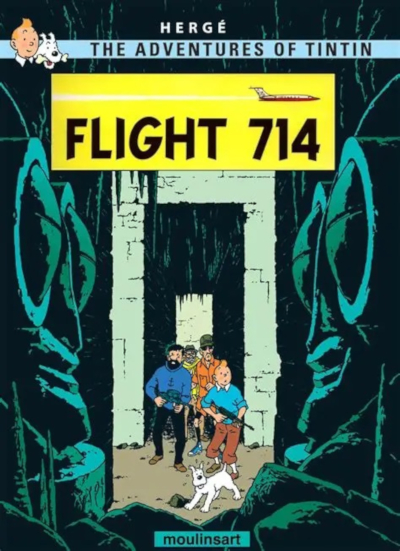
Flight
714 is the twenty-second and penultimate book in Hergé's much loved
Tintin series of adventures and was first published in 1968. What is
perhaps most extraordinary about Tintin is that he first appeared in
1929 (in Le Petit Vingtième, a children's supplement to the Belgian
newspaper Le XXe Siècle) and yet Hergé was still plotting new Tintin
adventures when he died in the 1980s. This enduring appeal proved
beyond doubt that Tintin was an iconic and mythic character, a friend
to millions of children in Europe and beyond. If you didn't grow up
reading Tintin and Asterix then I can only commiserate because you
missed out on an awful lot of fun. It would be no exaggeration to
suggest that books like Tintin in Tibet and Explorers On the Moon are
amongst the greatest graphic novels ever printed, their sense of wonder
with Hergé's signature ligne claire style always evident no matter how
many times you've opened those pages before.Tintin
is a reporter but we hardly ever see any evidence of this and he never
seems to have to report to a boss or a place of work. The sense of
freedom this gives the character (how many people in the real world can
embark on exotic adventures at the drop of a hat?) is of course
appealing. Tintin's main traits are his determination and sense of
fairness and decency. We know he will always do the right thing and if
villainy or some sort of injustice has occurred then our hero will not
rest until all is right again. Tintin is also the underdog, an ordinary
slight looking young man who battles criminal masterminds and dangerous
organisations. He is handy in a fistfight and seems adept at flying
planes and driving vehicles. He is brave, resourceful, level-headed,
and thoroughly kind and decent. All in all, the perfect hero for a
former boy scout like Hergé. Anyway,
what is the plot of Flight 714? As they were the first men to step on
the moon, Tintin and Captain Haddock - along with Professor Calculus
and Snowy the dog - are on their way to an Astronautical Congress in
Sydney which they have been invited to as honoured guests. At Jakarta's
Kemayoran Airport while their plane refuels though, they bump into
their old friend Piotr Skut from The Red Sea Sharks. Skut is now
working as a pilot for the eccentric and notoriously grumpy millionaire
Laszlo Carreidas, who famously hasn't laughed for many years. When
Professor Calculus accidently accomplishes this very rare feat and
makes Carreidas chuckle, the grateful millionaire offers Tintin and his
friends a ride to Sydney as guests in his luxury prototype private jet.Trouble
soon looms though for our heroes when the plane is hi-jacked at
gunpoint by the treacherous staff of Carreidas with the millionaire,
Tintin, Captain Haddock, Calculus and Skut all becoming hostages. The
plane is taken to the deserted volcanic island of Pulau-Pulau Bompa in
the Celebes Sea where Rastapopoulos - Tintin's most famous old enemy -
awaits. Rastapopoulos is determined to find out the number of the
secret Swiss bank account held by Carreidas but the unexpected presence
of Tintin and friends soon threatens to upset his plans as they all
gradually begin to realise that there is something very strange indeed
about this island...As with
Tintin and the Picaros, Flight 714 is another of those later Tintin
books that is obviously trying to be more up to date and bring the
character into the modern world. The book has a rather James Bondian
plot that soon becomes very strange indeed with Erich von Däniken's
(then trendy) theories obviously playing a role in the third act of the
increasingly far out story. It's always interesting to read Tintin
books and look at what they may have subsequently influenced and Flight
714 I suspect is a book that the writer of the film Indiana Jones and
the Kingdom of the Crystal Skull owes quite a bit to. Indiana Jones
meets Erich von Däniken meets James Bond would not be a million miles
away from a fair description of Flight 714 at times. Another
interesting parallel is with the television series Lost. In Flight 714
the characters find themselves trapped on a deserted jungle island as
they battle/chase around and gradually begin to notice that there is
something rather mysterious about the location. 'There's something
funny about this place,' says Captain Haddock early on. 'A weird
atmosphere.' He's not wrong either.Although
Flight 714 is generally very well regarded I find it slightly less
satisfying than some of the other classic Tintin adventures on the
whole. It's still fun but the story lacks the globe-trotting and/or
European atmosphere that one associates most with Tintin - the action
restricted to the jungly island with Tintin and company escaping and
being chased etc around Pulau-Pulau Bompa by Rastapopoulos and his
goons. Rastapopoulos is a little disappointing here and mostly played
for laughs rather than shown as a particularly brilliant or menacing
adversary. Rastapopoulos is the most famous of the Tintin villains (he
is, one could argue, to Tintin what Blofeld is to James Bond or
Moriarty is to Sherlock Holmes). Rastapopoulos was first introduced -
at least in a striking visual prototype - in a Tintin in America cameo
(sitting next to film star Mary Pickford) and then featured in The
Cigars of the Pharaoh, The Blue Lotus, The Red Sea Sharks and Flight
714. Flight 714 contains plenty
of Hergé's trademark humour although it's more spread out here and
therefore Captain Haddock gets off fairly lightly. Carreidas,
Rastapopulos, Calculus and Allan - the chief crony of Rastapopulos -
are all given some of the accidents and pratfalls that would usually go
the long suffering Captain's way. The grumpy but noble Captain
Archibald Haddock is Tintin's best friend and a constant if often
reluctant companion on his adventures. Haddock usually wants nothing
more than peace and quiet in the books but always finds himself dragged
along on Tintin's adventures out of a sense of duty. It was the
merchant marine veteran Haddock (named by Hergé after the "sad English
fish") and not Tintin who ultimately came to be Hergé's avatar the most
in the books. Tintin was Hergé
when the young artist and former boy scout began writing and
illustrating the stories but the increasingly weary Hergé seemed to
make Haddock his new alter ego as he grew older. Haddock - a drunken
wreck when Tintin first met and rescued him in The Crab with the Golden
Claws - injected some flawed humanity into the series to counter
balance the pure idealism and straight ahead heroism of Tintin. Haddock
is known for his colourful vocabulary when it comes to insults and his
love of Loch Lomond brand Scotch whisky. Haddock is a courageous and
decent character who is able to accept himself for what he is. One is
always aware that Hergé greatly admired this. There is a great joke
early on though where Haddock mistakes the disheveled Carreidas for a
down and out at the airport and slips five dollars in his hat when he
drops it, and the game of 'Battleships' between the Captain and
Carreidas on the private jet is good fun too.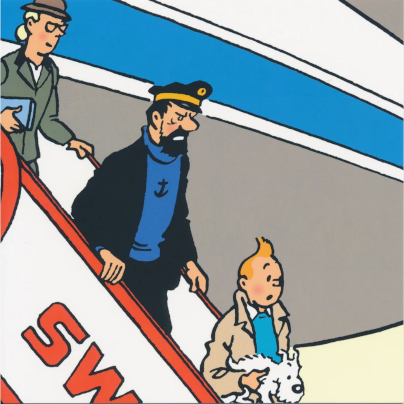
There
is also a great comic passage involving Rastapopoulos where he has
Carreidas injected with a truth serum to get the secret bank account
number out of him - only for Carreidas to then truthfully reveal
absolutely everything crooked about his life (except for the bank
numbers of course!) starting with him stealing a piece of fruit back in
1910! Rastapopulos then accidently becomes injected with the truth
serum himself after a struggle and the two men argue over who has been
the most dishonest in their lives! 'You doctor,' says Rastapopulos to
his assistant. 'I promised you forty thousand dollars to get the
account number out of Carreidas. And all the time I'd made a plan to
eliminate you when the job was done. The same goes for the others. The
Devil himself couldn't do it better!'There
is a fair bit of action, shooting and running around in Flight 714 with
the spectacular location making a nice backdrop. The drawings of the
Concorde style private jet of Carreidas circling the island and trying
to land on the tiny airstrip are nicely done too and we see it fly over
the sails of an old ship in a great panel. It's as if Hergé knew he was
coming towards the end of Tintin now and just wanted to have a big,
almost cinematic adventure for the characters. The action is just on
the verge of becoming a little samey and repetitive when it switches to
the subterranean world of the island and takes on a more mysterious and
surreal aura with telepathy and Tintin and Haddock perplexed as the
secrets of Pulau-Pulau Bompa are slowly revealed. There are some lovely
illustrations of stone statues, caves and volcanic eruptions in these
sections. One novel thing about Flight 714 is that it is an experience
that the characters - save for Snowy of course who can't speak! - have
no memory of whatsoever afterwards. It is like the forgotten Tintin
adventure.Flight 714 is not
really in my top tier of Tintin adventures but by most other standards
this is still very entertaining and amusing stuff with lovely
illustrations and the usual exciting spirit of adventure. That a layer
of X-Files type mystery is thrown into the mix adds to the overall
interest of the story - which occasionally veers towards being a little
too straight ahead and action oriented after a great opening. A good
read on the whole though, this is one of the more cinematic and famous
of the Tintin stories and recommended.
- Jake
© 2025
Alternative 007
|


|