|
Bruce Lee Triple Bill - The Big Boss, Fist of Fury, Way of the Dragon!
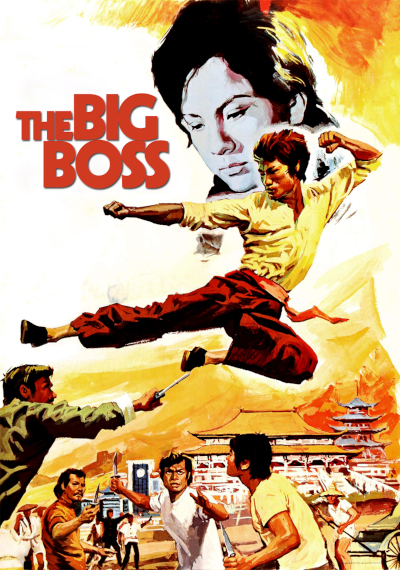
Bruce
Lee's Hong Kong films can best be described as unsophisticated and were
made very quickly and very cheaply. They derive from the Chinese
theatrical tradition where nothing is ever too subtle and to say the
humour doesn't always translate beyond its intended audience would be
something of an understatement. However, you do not watch a Bruce Lee
film for the acting, story or cinematography. You watch a Bruce Lee
film to see Bruce Lee performing dexterous athletic feats and uncanny
kicks and punches beyond the realm of most mortals. Lee wasn't quite an
overnight success but once he got his start in films there was never
any doubt that he was going to become a huge star. He was charismatic,
intelligent, highly skilled, lightning quick, incredibly dedicated, and
a master at choreographing fight sequences. He only made five films
before his premature death but they were enough in the end to make him
one of the pop culture icons of the 20th Century. Lee revolutionised
the Hong Kong film industry and martial arts genre and paved the way
for everyone and everything from Jackie Chan to The Matrix. It's fair
to say that he was somewhat ahead of his time (especially when one
considers the influence of Hong Kong cinema on Hollywood in recent
years). Lee was
born in San Francisco but grew up in Hong Kong. He returned to the
United States as a teenager and soon became obsessed with becoming the
greatest martial artist he could possibly be. Hollywood actors like
Steve McQueen and James Coburn became his students and when he started
giving public demonstrations of his kung fu, television executives were
impressed enough to start providing screentests and a little acting
work here and there. But it was Hong Kong that he would eventually have
to turn to in the end to become a real star. The Big Boss was directed
by Lo Wei and released in 1971. It was Bruce Lee's first leading film
role although he'd already appeared on American television, most
famously in The Green Hornet - a sister show to Adam West's Batman. Lee
played Kato, a masked kung fu chauffeur sidekick to the crime fighting
Green Hornet. The Green Hornet was axed after a year and Lee didn't
care much for the part of Kato anyway. He was increasingly frustrated
by his lack of opportunities and progress in the United States but
pleasantly surprised to learn that he was more famous in Hong Kong
where The Green Hornet - and the character of Kato in particular - had
been popular. Lee decided
that he would have to take one step back to take two steps forward.
Actors like Clint Eastwood had become famous and icons of the screen by
making films abroad before they had any great success in Hollywood and
he would do the same. The difference being that "abroad" in this case
was home. Lee signed a two film contract with Golden Harvest Studios
for $15,000. It wasn't a fortune but it was a start in films and Lee
also got his air fare to the shooting location in Bangkok paid as part
of the deal (he wasn't too impressed though when he arrived in Bangkok
and found himself in a tiny insect infested hotel with no air
conditioning and water that wasn't safe to use). Golden Harvest were
run by a man named Raymond Chow and at that time their modest
headquarters consisted of a collection of shacks in Kowloon. Chow was a
former employee at the more famous Shaw Brothers studios in Hong Kong
but now he was their bitter rival and no love was lost between the two
companies. Chow and Run Run Shaw
had competed in something of a battle to sign Bruce Lee but Chow won in
the end because Shaw's initial offer was derisory. By the time he made
a more tempting and respectful one, Bruce Lee had already signed to the
fledgling Golden Harvest and felt duty bound to honour his contract. It
was Bruce Lee that established Golden Harvest as a force in Hong Kong
cinema and they went on to enjoy considerable success in the future
with Jackie Chan (who appears in a couple of these films as a stuntman
and took a few kicks from Bruce Lee for his art). Lee was strongly
advised by some of his famous actor friends in Hollywood not to sign a
deal in Hong Kong under any circumstances. The money was terrible and
Golden Harvest were yet to become a player in Hong Kong and famed for
cranking out bargain basement martial arts films that were practically
indistinguishable from one another. The Big Boss had a total budget of
$100,000, which was peanuts even in 1971. You probably couldn't even
have made a commercial in the United States for that money let alone a
full length film. Golden Harvest
films were usually rushed into production with a brief outline or
premise rather than a screenplay and shot with no sound so everything
could be dubbed later. An unimpressed Lee watched some of these films
and felt sure that he could do much better, especially of course when
it came to the fight sequences. He had no choice in the end but to take
over the production of the film as much as possible and quickly
realised life with Golden Harvest wasn't going to be easy when he would
sometimes turn up for work on the set and find he was the only person
there! The original director Wu Chai Wsaing was so obnoxious and rude
to the cast and crew he was swiftly fired and his replacement Lo Wei
wasn't much better. Wei and Bruce Lee did not get on at all. Lee
thought Wei was lazy and a terrible director while Wei dubbed the actor
a hypochondriac and later made a ludicrous claim that he'd personally
taught Bruce Lee how to fight on the set of The Big Boss! In The Big
Boss, Bruce Lee is Cheng Chao An, a young man who has moved to Thailand
to escape a troubled past and start a new life in a country where his
cousins Hsu Chien (James Tien) and Chiao Mei (Maria Yi) are already
living. Chen has made a promise to his mother that he will not get into
any more trouble and - most of all - never fight again despite being
highly skilled in the art of kung fu.In
order to remind himself of this vow Cheng Chao An wears his mother's
locket around his neck. Early on he witnesses a girl at a roadside
drinks stall being bothered by some louts and wistfully gazes at the
locket instead of leaping into action. You don't need to be a genius to
work out that this restraint is not going to last for the duration of
the story. Cheng gains some employment at the local ice factory but the
vow he made to never get into any trouble or throw a punch in anger is
about to be put to the most severe test. Two of the the workers
discover that some of the blocks of ice are being used to transport
drugs and when they get too curious for their own good they are killed
by the goons of "The Big Boss" of the factory Hsiao Mi (Yin-chieh Han).
The other workers soon become suspicious about the missing pair and go
on strike. Hsiao Mi (the boss in case you'd forget) has no tolerance
whatsoever for workers banging on about missing employees and slacking
off and sends some of his heavies in to put a stop to this militant
protest and a violent pitched battle breaks out between the the Chinese
workers and the Thai goons. But Cheng honours his promise to his mother
and keeps his beak out of this mass brawl. Until that is a metal hook
hits him in the head and he finally enters the fray, dispensing with
dozens of Thai heavies in classic Bruce Lee fashion.The
boss, noting the remarkable fighting skills of the young Chinese
upstart, decides to use divide and conquer tactics. He promotes Cheng
and gets him drunk at a party so it looks like he is consorting with
prostitutes (though in reality Cheng is always the innocent). Cheng is
now ostracised by the other workers and considered to be a complete
sell-out and fraud but he has a chance to become a hero again when he
discovers the truth about the operation run by the crooked Hsiao Mi.
The fact that The Big Boss is not the most lavish production ever
committed to film is apparent right from the start with the shaky
titles at the start and the terrible jazz muzak that punctuates some of
the action. It was certainly an eventful introduction to the Hong Kong
film industry for Lee with the two inept directors and the script
consisting of a couple of ideas scribbled down on paper. Lee took it
upon himself to take over as the choreographer of the fight sequences
and also did his best to come up with more of a story, practically
making it up as they shot. He also had to contend with a badly sprained
ankle from a jump and a terrible fever. Lee would have to get
injections for back pain after every scene and the shoot quickly became
something of an ordeal to him.Despite
all the problems - and The Big Boss looking as if it cost less to
produce than an episode of Prisoner Cell Block H - there is ample
compensation for your time whenever Bruce Lee is pressed into action as
Cheng. Hong Kong kung fu films were incredibly comic book at the time
with exaggerated feats of flying through the air and wielding weapons.
Lee was a new type of martial arts hero in that most of what he did
seemed plausible yet was still remarkable. In fact, he was so fast he
sometimes had to slow down his kicks and punches in fight scenes
because they only registered as a blur otherwise. The film drags a
little at the start when the reluctant Lee is still bound by the vow to
his mother not to fight and also struggles to maintain one's interest a
little when our hero is temporarily attracted to the temptations thrown
his way by Mi but the fight sequences themselves are superbly
orchestrated and Lee has great presence. He just looks iconic even when
he isn't doing anything and the (deliberate) absence of too much
dialogue in these films always works in his favour. Lee's
final showdown with The Big Boss is well staged (even if Yin-chieh Han
does look like a complete wimp!) and the Bangkok locations work quite
well. The Big Boss was never going to be Lawrence of Arabia but as far
as these things go isn't bad at all. One thing you do notice about the
film though is that it seems rather gruesome compared to the other
Bruce Lee pictures. When Lee wields a knife and slashes someone you see
stage blood like something out of Friday the 13th and a particularly
violent scrap results in someone being offed with a saw. It's like a
kung fu video nasty at times and I was surprised at just just how
bloody it got. The Big Boss is raw and cheap and has unintentionally
comic moments with the terrible music and broad performances but it's
got Bruce Lee in it and that's all you really need to know.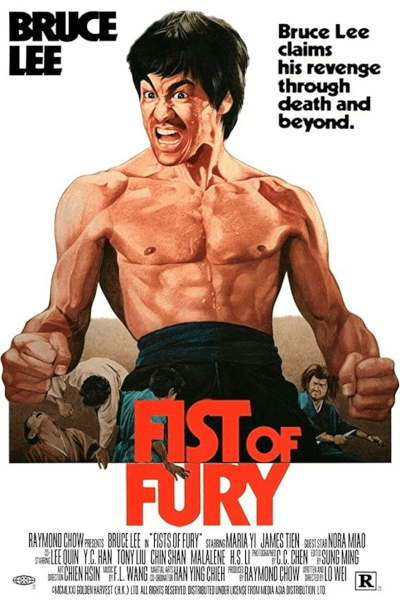
Fist
of Fury was directed by Lo Wei and released in 1972. Like The Big Boss
this went into production with not much more than an outline by way of
story and also had to get around what was by Western standards a
minuscule budget. The production values are modest but Fist of Fury
does seem a little more professional than The Boss on the whole. Not
that this is saying an awful lot but a Spaghetti-Western style
soundtrack has been added and as ever one forgets about the crudeness
and bargain basement nature of the film when Bruce Lee is onscreen
displaying his athletic prowess and punching and kung fu kicking. As
usual the film was shot with no sound and then dubbed later on. Legend
has it that Lee had to be restrained from throttling the inept director
Lo Wei again because Wei was more interested in the racetrack than the
film and would have commentary from whatever horse race he had bet on
that afternoon blaring away on a loudspeaker while they were trying to
shoot the picture. Despite the haphazard nature of the production this
was the film that made Bruce Lee a mythic Chinese hero and was
something of a personal breakthrough (although he would only become an
international star posthumously through Enter the Dragon), breaking
box-office records in Hong Kong. Fist
of Fury was a huge hit in the Philippines and Singapore, so much so
that some Far Eastern markets eventually withdrew Fist of Fury to give
their own domestic films a fighting chance in cinemas. The success of
the picture in its more native markets resides in Fist of Fury's
straight ahead playing on the deep animosity between China and Japan
with the Japanese very much the villains. The story is set in the early
part of the last century and was inspired by the real life death of a
Chinese martial arts teacher named Ho Yuan Chia. Bruce Lee plays
Chinese folk hero Chen Zhen, a student and martial arts expert who
arrives in Shanghai (where the Japanese have of course established a
strong political presence) to visit his old master and teacher Huo
Yuanjia. Chen is distraught to learn that his master has died and is
immediately suspicious of foul play as Huo appeared to be in perfect
health and was known for being someone who stood up against Japanese
intimidation.The memory of his
late master is then insulted by Mi Wu (Paul Wei), an oleaginous Chinese
who works for the Japanese as a translator. Mi Wu arrives at Chen's old
Chinese Jingwu martial arts school with students from the Japanese
Bushido School. They present a banner inscribed with the words "To the
Sick Nation of Eastern Asia" and goad Chen and the Chinese students,
declaring that the Japanese are the superior race and the superior
martial artists. Chen is so infuriated he goes to the Japanese martial
arts school and defeats all of the students (and their master) in
vicious combat before making them tear up the insulting banner Mi Wu
presented them with. Chen is now a wanted man and must go into hiding.
He is still though determined to get to the bottom of the death of Huo
and avenge his beloved master. This is one of the most violent of the
Bruce Lee films although in terms of action it actually seems to have
the least amount of fighting sequences. The film shamelessly mines the
resentment the Chinese still felt towards the Japanese after centuries
of conquest and hostility and so the villains are completely one
dimensional and have no humanity or shades of grey whatsoever. When
Lee defiantly insisted that the Chinese were not a "sick nation" in the
Japanese dojo and angrily kung fu kicked a sign in a park that said "No
dogs and Chinese allowed", Hong Kong Chinese audiences stood up and
cheered in cinemas, delighted to suddenly have this charismatic and
apparently superhuman new film hero proudly declaring his pride in
China. Lee only has two major fight sequences in the film but he makes
the most of them. One occurs in the Japanese martial arts school and
the other near the end when Chen's revenge mission lands him in a
traditional Japanese garden with bridges and pools (the crafting of
this garden was responsible for swallowing most of the tiny production
budget). The fight in the Japanese school is excellent and remains
influential (Jet Li riffed on it twice - in a remake of Fist of Fury
entitled Fist of Legend and in the later Kiss of the Dragon). Lee, who
looked down his nose at karate, took particular pleasure in filming a
sequence where his own fluid and collective fighting system Jeet Kune
Do was too much for traditional Japanese martial artists with their
rigid doctrines.This seems to be
the film where Bruce Lee started to noticeably make a lot of strange
wailing cries as he dispenses with his overmatched opponents and the
effect is strangely compelling despite the fact that it has become
(with the possible exception of jokes about dubbing) the most lampooned
cliche of this genre. Even in the English language version Lee's cries
and wails are his own. The dubbing is comical but then these films are
only really supposed to be watched with subtitles in my view. Lee is
much more volatile here than in the other films and seems to be tightly
coiled with an anger and frustration he can barely contain. Chen kills
a lot of people too without too much concern (something that Jackie
Chan studiously avoided when he picked up Lee's baton as the premier
star of Hong Kong Golden Harvest cinema) and Bruce Lee's athleticism,
grace and speed is as always astonishing at times. You also of course
get the nunchucka (the wood sticks connected by a chain that can be
swung and used to strike people) capers reinstated too. If you've only
ever watched these films on British television you'd be surprised at
times at how much they cut and nunchuckas for some reason seemed to be
a particular problem for British censors. I've
never watched a Bruce Lee film and then had an overwhelming urge to go
out and maim someone with some homemade nunchuckas myself but some
censor obviously thought otherwise! Lee used slightly lighter than
usual ones in the film and his dexterity with them is balletic. It's an
art. There are a few silly bits that grate somewhat amongst the more
rational (and always enjoyable) fight sequences. Lee performs a highly
unlikely leap at one point that looks as if it had the obvious aid of a
trampoline and also lifts a rickshaw up as if he has super strength.
Bruce Lee didn't really need any gimmicks like this to appear as if he
was an extraordinary hero onscreen and these moments simply detract our
attention from and threaten to diminish his more believable but
uniquely sublime athletic exhibitions and high speed kicks and punches.
The other characters are mostly hopeless caricatures and it is only
Chen Zhen who seems to have any complexity or ability to think about
the consequences of his actions. His thirst for revenge puts his old
school and the Chinese students in danger and he must ponder whether or
not his actions have gone against what he has been taught. The
film establishes the intrigue and danger that exists between the
Chinese and Japanese martial arts schools and there is much scheming
between them (and one big confrontation) but one often feels that the
potential of this premise is never quite fulfilled and that Fist of
Fury never really becomes the bargain basement epic it might have been
in more capable hands. You have to put up with an awkward romantic
sub-plot involving Lee and Nora Miao as the fiancee too. I don't think
Bruce Lee was ever going to become a romantic hero! He was the strong
silent type. The hero who must always stand alone. Things threaten to
get too risible for their own good when Chen adopts a series of
Inspector Clouseau type disguises to go undercover amongst the Japanese
but Fist of Fury - like all of Bruce Lee's films - delivers the goods
in the fight sequences and remains good low-budget fun.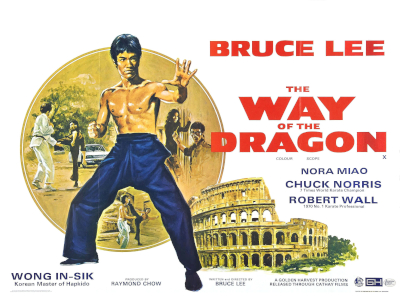
Way
of the Dragon is a 1972 film that Bruce Lee directed and conceived
himself. The success of Fist of Fury made Bruce Lee a superstar in Hong
Kong and the Far East and his two picture contract with Golden Harvest
and Raymond Chow had now expired. What he really wanted to do was land
the lead role in The Warrior - a television series he had frequently
tried to pitch to Warners and the ABC network in the United States
about a serene wandering Shaolin warrior-priest in the Old American
West who is reluctant to use his deadly martial arts skills but will do
so to help those in desperate need. Lee was devastated when he got a
telegram from Warners telling him that he would not be involved in the
series as his casting had been rejected by the network. The Warrior was
renamed Kung Fu and - to add insult to injury - the part of the Chinese
warrior-priest that Lee had so coveted went to the white American actor
David Carridine. With Hollywood apparently not yet ready to cast a
Chinese actor in such a leading role, Lee set about setting up his next
Hong Kong project instead. Now out of contract, he turned down numerous
offers, including one from Shaw Brothers - who were still mortified on
missing out on signing the rising star in the first place and promised
him twenty times more than whatever Golden Harvest were paying. Lee
still though took full advantage of the strength his sudden fame and
adulation had given him. He met with Raymond Chow and suggested that
instead of signing a new contract with Golden Harvest they should
become partners and set up a new production company to make more films
for the studio. Chow would look after the business side and Lee would
have full creative control over his work. Chow was in no position to
argue (even a half-share association with Bruce Lee was like sitting on
a goldmine in Hong Kong) and abandoned the plans he'd had for Lo Wei
direct Lee in a film called Yellow-Faced Tiger. Lee wanted nothing more
to do with Lo Wei after the disinterested and amateurish fashion in
which the director had approached Fist of Fury and decided he would
write and direct his next film. With his new found autonomy and freedom
(and a slightly larger if still hardly lavish budget of $130,000), Lee
enthusiastically began work on Way of the Dragon. Having
turned the Hong Kong film industry upside down (studios were not used
to having terms dictated to them by actors), Lee wanted to challenge
preconceived notions of what people expected from Hong Kong kung fu
films (most of which he thought were absolutely terrible). Way of the
Dragon would import Western martial arts stars to fight Lee and would
also be the first Hong Kong film to shoot in Europe. As it turned out
though, Way of the Dragon was as raw and cheapjack onscreen as his
first two films but it did feature one of the greatest and most famous
fight scenes of his career and if you can get through the less than
subtle acting, slapstick, and idiotic and occasionally incomprehensible
interludes then there is some fantastic material involving Bruce Lee to
reward you. In the film Bruce Lee plays Tang Lung, a simple country boy
who leaves Hong Kong to help his cousin Chen Ching Hua (Nora Miao) and
other family members who run a restaurant in Rome. A worried Chen
explains that the restaurant she inherited is situated on land wanted
by the Mafia. The Mafia have been sending heavies to intimidate the
staff and drive away customers and she is at her wits end.As
expected (by the audience anyway) Tang proves to be more than a match
for these Mafia goons when he arrives at the restaurant and his
incredible kung fu skills have the Mafia heavies scuttling away to lick
their wounds and the Chinese waiters at the restaurant hugely impressed
and eager for martial arts lessons from their unexpected new protector.
But the Mafia boss (John T Benn) and his lieutenant Ho (Wei Ping Ao)
are not ready to give up on the land so easily. They intend to use
bullets and if that doesn't work have hired three highly skilled
foreign martial artists to challenge and hopefully defeat Tang. A
Japanese karate instructor (played by Korean Hapkido master Hwang
In-Shik) and American karate stars Bob Wall and Chuck Norris as
characters named "Fred" and "Colt" respectively. Some famous
confrontations are now on the horizon. Way
of the Dragon is often played as a comedy (the character played by Lee
is frequently much lighter and more naive than the one he played in
Fist of Fury) and the most polite thing to say is that the humour
doesn't always work if you are not Chinese and sitting in a Hong Kong
cinema in the early seventies. When Bruce Lee arrives in Rome at the
start of the film there are some fairly bizarre and not very funny
antics involving his search for a toilet and Tang ordering several
bowls of soup in a restaurant by mistake because he doesn't understand
the local lingo. Every single joke and sight gag is hammered home by
the somewhat annoying wah wahs on the soundtrack - just in case we had
missed any of these side splitting interludes. What is interesting here
is the way you have to wait about half an hour before Bruce Lee
actually does anything in the way of fighting. It's as if he knows
that's the only reason anyone is watching this film so he's going to
make you wait and look at something else first. The
pedestrian early pace of the film and the comic vignettes (and the fact
that it appears to be rather similar in plot to The Big Boss) make one
fear for the worst but Way of the Dragon becomes something of a cheese
laden minor cult classic once it finally kicks into gear. There are
some great scenes where Lee practices his kung fu alone and the
sequences where he gives the Chinese waiters some lessons in an alley
behind the restaurant are hugely enjoyable. Tang kicks a punching bag
and sends the man who was holding it flying in comic fashion. These
moments are of course much more natural and amusing than Bruce Lee
ordering eight bowls of soup or desperately needing to use the bog. The
use of Western martial artists in a Hong Kong film was revolutionary at
the time and the imposing Bob Wall (who went on to star with Lee in
Enter the Dragon) is good value as usual. Wall was fully prepared to
take a few hits for real for the sake of authenticity and so his fight
sequences are as ever very good. Chuck
Norris (rest in peace) was completely unknown at the time as far as
acting went but a real life karate champion of some distinction. His
showdown with Lee inside the Colosseum in Rome is the highlight of the
picture and one of the most memorable sequences Lee was ever involved
in. The pair confront one another with the respect and formality of
samurai warriors and an epic contest ensues. Bruce Lee cast Norris
because he found that few martial artists or stuntmen were fast enough
to believably fight him onscreen. Norris was different and it made
their staged fight much more authentic and all the more inspired for
the setting (although the Colosseum backdrop sometimes looks noticeably
fake when the location footage in Rome cuts to studio interiors). Lee
spent nearly 50 hours working on the scene and choreographing with
Norris and if a single movement wasn't to his liking he would scrap it
and reshoot until it was perfect. The respect of the two combatants as
they fight to the death is rather touching and there are some clever
little touches. Lee snatching a clump of the hirsute Chuck's chest hair
in his hand and the fact that their only audience is a stray kitten. Notice
how Lee eventually becomes more limber and fluid and bounces up and
down on his toes in order to become more unpredictable and harder to
hit for his opponent. He was inspired by watching film of master
defensive boxers Muhammad Ali and Willie Pep and wanted to show how a
dexterous and versatile fighting system would be too much for the
rigidity of karate. Not sure how Chuck Norris felt about this but he
was a friend of Lee and just happy to be in the film I suppose. Maybe
it never occurred to him much at the time. While there is never any
doubt about who is going to win (Bruce Lee was the writer, director and
star!) I like the way they make the fight competitive with a bit of
ying and yang. One thing worth mentioning here is that the villains try
to shoot Bruce Lee with guns. This is worth discussion because guns
were something of a rarity in old kung fu films and probably led to
countless people decades later shouting "Why don't they just shoot
him?" at their television screen. Bruce Lee uses blow darts to disable
those trying to shoot him here and the absence of guns in most kung fu
films was not merely a convenient plot contrivance. Places in the Far
East like Hong Kong and Singapore had experienced the British tradition
of unarmed police and strict gun control and so really did settle their
disputes with their fists! Way of the Dragon is another good bad film.
It's often terrible but brilliant when Lee is doing something. I must
mention Wei Ping Ao too. The campest villain sidekick in cinema history
and what a terribly evil laugh! -Jake
© 2026
Alternative 007
|
|